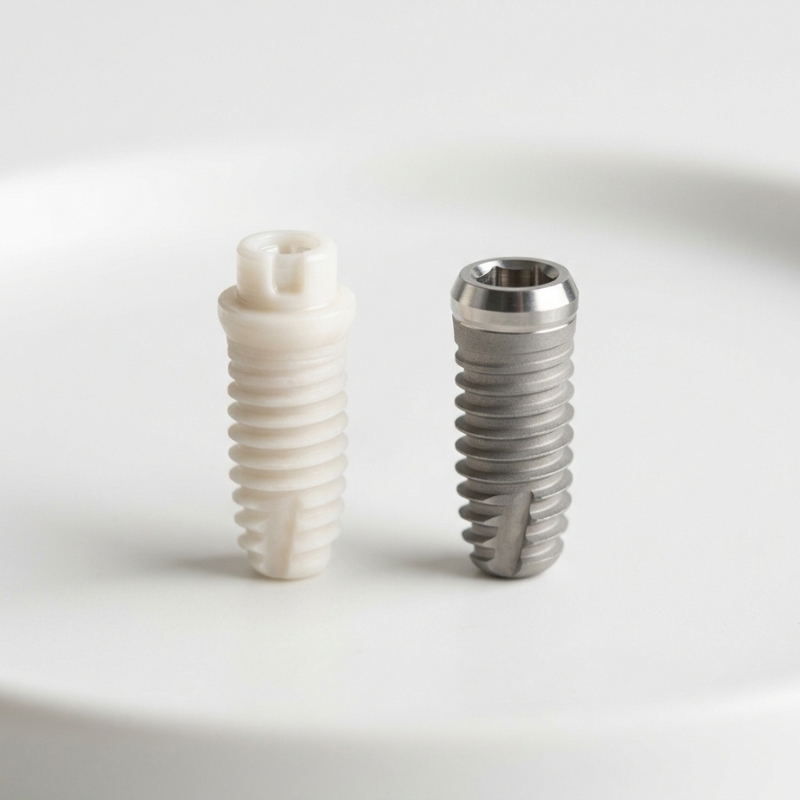
What Is a Zirconia Dental Implant?
A zirconia dental implant is an implant whose fixture and abutment are made of zirconia, a white ceramic in the same family of materials already used for dental crowns. There is no metal in it, which is what metal-free dental implants means on this page.
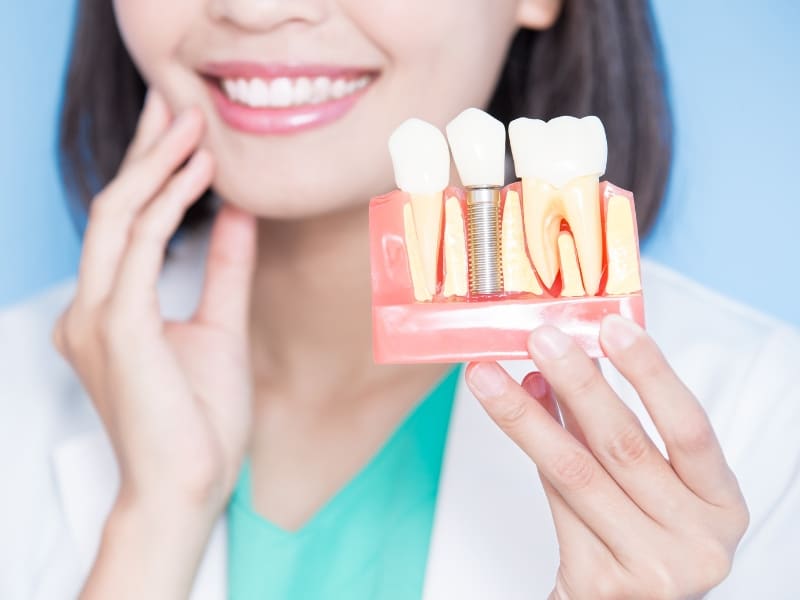
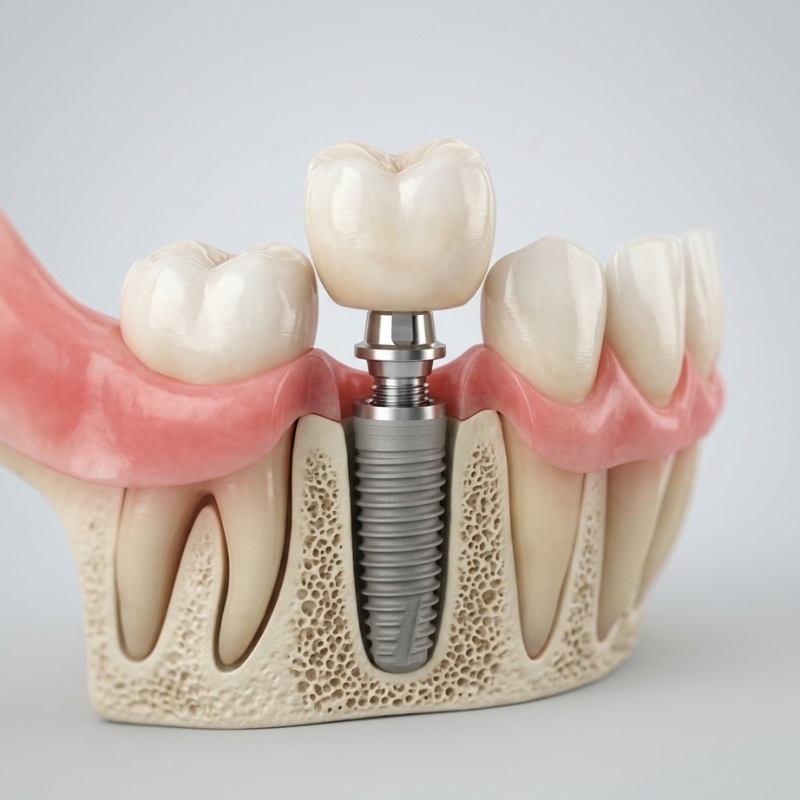
Every dental implant, ceramic or titanium, has the same three parts. The fixture is the post that is placed into the jawbone and replaces the tooth root. The abutment is the connector that sits at the gum line. The crown is the visible part of the tooth. In conventional titanium dental implants, the fixture, and usually the abutment, is made of titanium. Ceramic dental implants are not.
Ceramic implants come in one-piece and two-piece designs. A one-piece implant is a single component, fixture and abutment together. A two-piece implant has a separate abutment, which gives more control over the angle the crown sits at, and that matters most at the front of the mouth, where the tooth has to line up with the ones beside it.
We use the ZERAMEX two-piece ceramic system. Implant systems are not interchangeable, and pooled research has found that implants from discontinued brands survive less well than those from established, currently marketed systems. Hence, the choice of system is a clinical decision rather than a preference.
Zirconia or Titanium, How the Two Compare
Titanium has the longest published clinical record, and zirconia has a tooth-coloured appearance and no metal. For most patients, either material will work, so the choice is made on a case-by-case basis rather than as a rule.
| Consider | Zirconia (ceramic) | Titanium |
| Material | White ceramic, no metal | Titanium alloy |
| Appearance at the gum line | Tooth-coloured, no grey shadow where gum tissue is thin | Can show as a grey line through thin gum tissue |
| Published clinical record | Good, but shorter. The pooled data spans about ten years. | Longer. Ten-year data across many prospective studies. |
| Behaviour under load | Ceramic so that it can fracture rather than bend | Metal, so it deforms rather than fractures |
| Design options | One-piece and two-piece systems | Wide range, long-established |
| Commonly used for | Front teeth, thin gum tissue, patients who want no metal | The default in most cases, including complex ones |
Zirconia ceramic implants and titanium implants compared
What the research says
A 2024 systematic review and meta-analysis in Clinical Oral Investigations pooled 25 studies covering 4,017 zirconia implants in 2,083 patients and reported a ten-year cumulative survival rate of 95.1 per cent. Fracture accounted for 26 of those implants, or 0.65 per cent (Mohseni, Soufi and Chrcanovic, 2024).
For context, a 2019 systematic review in the Journal of Dentistry, covering 18 prospective studies of conventional implants, reported a 10-year survival of 96.4 per cent, falling to 93.2 per cent after adjustment for patients lost to follow-up (Howe, Keys and Richards, 2019).
When compared directly, a 2023 meta-analysis in Clinical Oral Investigations found no statistically significant difference in survival between the two materials, based on two randomised trials involving 199 implants followed for 12 to 80 months. The authors describe the finding as short-term (Padhye and others, 2023).
The honest position is that zirconia has less long-term evidence behind it than titanium, and the researchers say so themselves. We would rather tell you that than leave you to find it out afterwards.