
If you’re researching dental implants, you’ll quickly run into a choice of materials: long-established titanium, or newer ceramic (zirconia) implants. Both are safe, well-studied options, and neither is simply better than the other; it comes down to your case and your preferences. This guide from Marsfield Dental Care in Sydney gives you a balanced comparison of the two, so you understand the differences and who each tends to suit before you discuss metal-free (ceramic) dental implants with your dentist.
| Quick answer
Both titanium and ceramic (zirconia) dental implants are safe, well-researched options. Titanium has the longest track record and broad flexibility; ceramic is metal-free, tooth-coloured and may suit people who prefer a metal-free option or have thin gums in the smile zone. Your dentist recommends the best fit for your case. |
Titanium implants: the established standard
Titanium has been used in dental implants for decades and is the material most implants are still made from, which gives it the longest track record of any option. There are good reasons it’s the standard. It’s strong and durable, standing up to the forces of biting and chewing over the long term. It integrates reliably with bone, a well-understood process that’s the foundation of a successful implant. And it’s versatile: titanium implants commonly come as a two-piece design, with the post and the abutment as separate parts, which gives the dentist flexibility in how the implant is placed and restored, and makes them suitable for a wide range of cases, including more complex ones. Decades of use and research mean the way titanium performs over time is very well documented, which gives both dentists and patients confidence in it. For most people and most situations, titanium remains a dependable, proven choice, which is why it’s still so widely used. One cosmetic consideration is that it’s a grey metal, which we’ll come to when we look at aesthetics. It’s also widely available and well supported, so if a component ever needs attention years down the track, the parts and the expertise are easy to find, and that long history is a genuine reassurance for a lot of patients.
Ceramic (zirconia) implants: the metal-free option
Ceramic implants, made from zirconia, are a newer alternative for people who’d prefer to avoid metal. They’ve become a genuine option in their own right, and they have some distinct features. The main one is that they’re metal-free, which appeals to people who prefer a metal-free approach or are concerned about metal sensitivity. They’re also tooth-coloured rather than grey, which is an aesthetic advantage in certain situations. In particular, if you have thin gums in the smile zone- the front teeth that show when you smile- a grey titanium post can sometimes show as a slight shadow through the gum, whereas a white ceramic implant avoids that. Zirconia is a strong, biocompatible ceramic that the body tolerates well. Ceramic implants are often a one-piece design, which suits many cases, though it offers less of the two-stage flexibility that titanium’s two-piece design allows. They’re a good example of how implant options have broadened, and for the right person and the right case, they’re an excellent choice. Your dentist can advise whether your situation suits them. As a newer option, ceramic doesn’t yet have titanium’s decades of long-term data, but the research so far is encouraging, and it’s a well-established choice in the right hands. Some people simply feel more comfortable with a metal-free option in their body, and that preference is a valid part of the decision.
Ceramic vs titanium: a side-by-side
Here’s how the two materials compare on the points that usually matter:
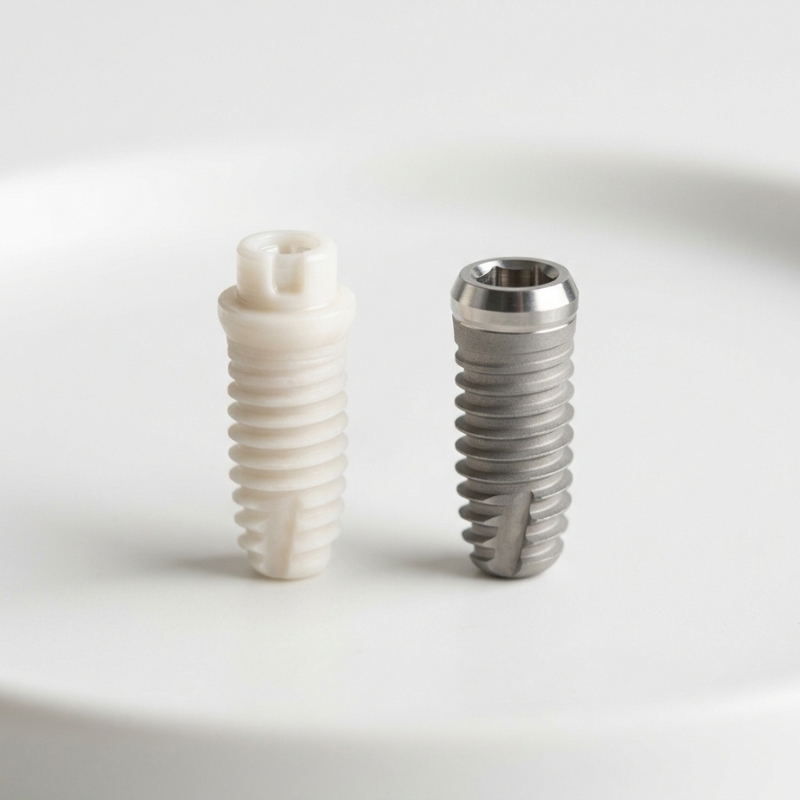
Ceramic versus titanium dental implant comparison
- Material: titanium is a long-established metal; ceramic (zirconia) is metal-free.
- Appearance: titanium is grey; ceramic is tooth-coloured.
- Gum aesthetics: ceramic can be better where gums are thin in the smile zone.
- Flexibility: titanium’s two-piece design suits a wide range of cases, including complex ones.
- Suitability: both are strong and biocompatible; the best fit depends on your case.
Which is right for you?
There’s no universal answer, and the right material is decided with your dentist after looking at your specific situation. A few things guide the choice. If you have a known metal sensitivity or simply prefer a metal-free option, ceramic may appeal. If aesthetics in the smile zone are a priority and your gums are thin, a tooth-coloured ceramic implant can have an edge. If your case is more complex, or needs the flexibility of a two-piece system, titanium’s long track record and versatility may make it the better fit. Your overall health, your bone and the position of the tooth all factor in too. The good news is that both are proven, safe dental implants, so it’s less about one being right and more about which suits you. That’s exactly what a consultation is for: your dentist assesses your case and recommends the material that will give you the best result. It’s worth going in without a fixed idea of which you want, since the right recommendation often depends on details of your gums and bone that only an examination reveals.
Frequently asked questions
Are ceramic implants as strong as titanium?
Zirconia ceramic is a strong, durable material well suited to dental implants, and it stands up to normal biting and chewing. Titanium has the longer track record and a two-piece flexibility that suits a wider range of cases. Both are strong options; your dentist will advise which suits your particular case best.
Do metal-free implants look more natural?
They can, in certain situations. Because ceramic implants are tooth-coloured rather than grey, they avoid the slight shadow a metal post can sometimes cast through thin gums in the smile zone. For front teeth where the gum is thin, that can look more natural. In many other positions, both materials give an excellent result.
Can anyone get ceramic implants?
Ceramic implants suit many people, but not every case, which is why an assessment matters. Factors like the position of the tooth, your bone, and whether your case needs a two-piece design all affect suitability. Your dentist will examine your situation and let you know whether ceramic or titanium is the better option for you.
Final thoughts
Titanium and ceramic implants are both safe, effective options, and the right one depends on your priorities and your case rather than one being universally better. Titanium brings a long track record and flexibility; ceramic offers a metal-free, tooth-coloured alternative. The way to know which suits you is a proper assessment. Ask about metal-free implants at Marsfield Dental Care and your dentist will recommend the best fit.
| Book a consultation
Interested in a metal-free option? Ask about metal-free implants at Marsfield Dental Care, or call 02 9887 1961. |

