Zirconia and Metal-Free Dental Implants in Sydney

Tooth-coloured ceramic implants at our Marsfield practice, for patients who would rather have an implant without metal.

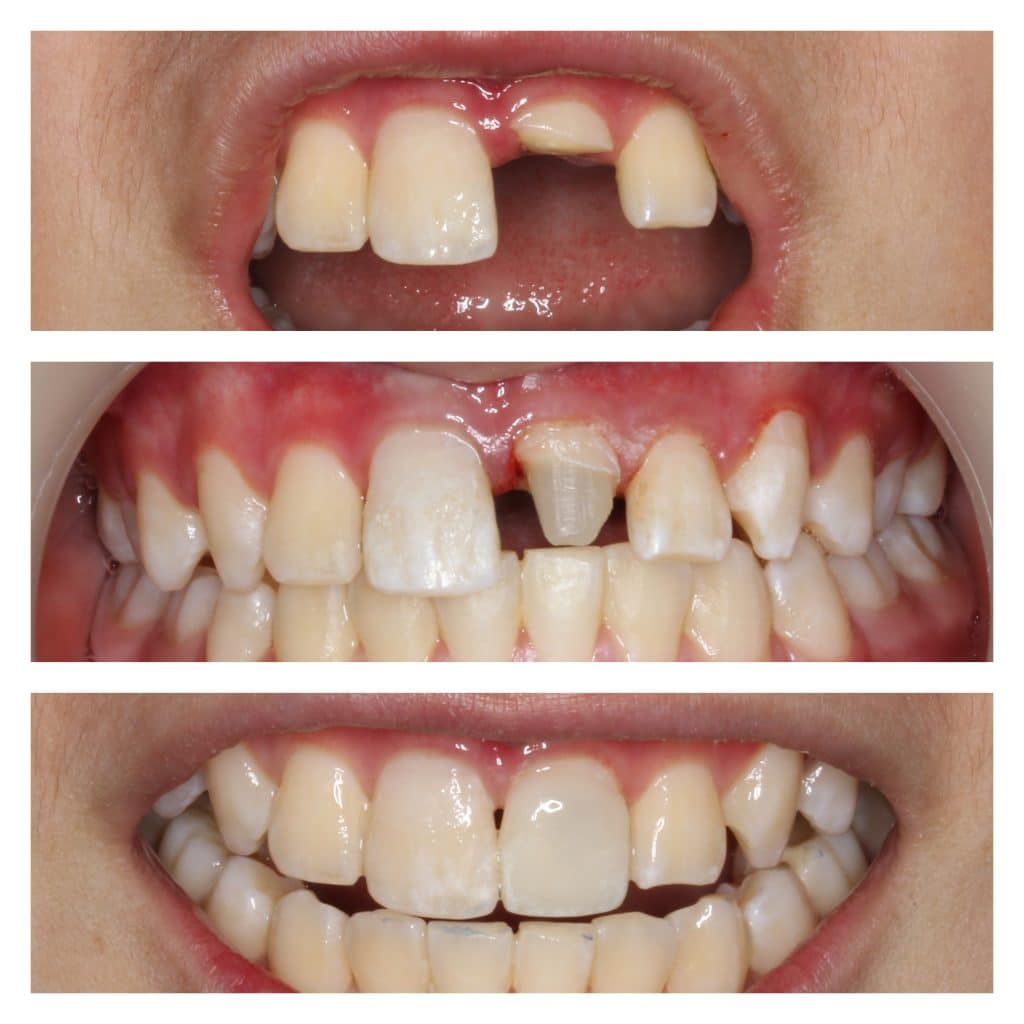
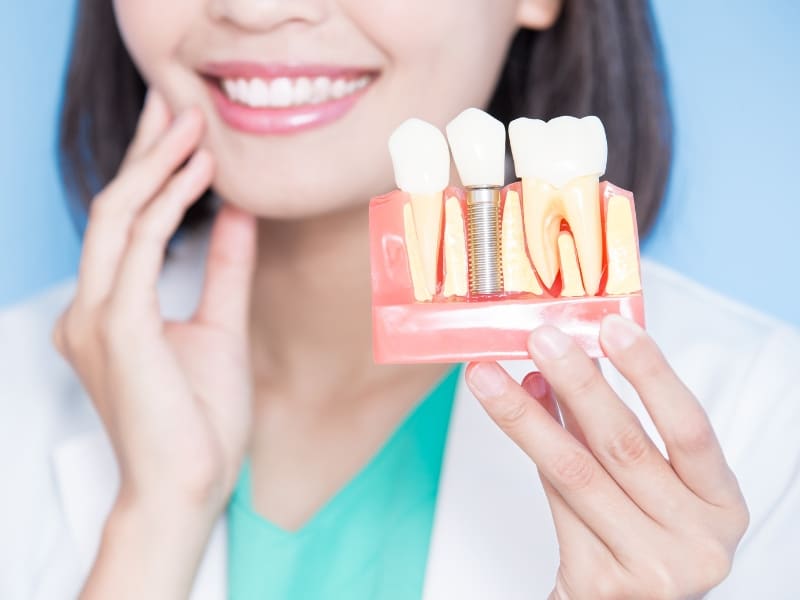
A zirconia dental implant is a tooth replacement made from a white ceramic rather than from titanium. Like any implant, it has three parts: a fixture placed in the jawbone, an abutment that sits at the gum line, and a crown on top. Marsfield Dental Care places zirconia implants at our practice on Waring Street, Marsfield, for patients who would prefer an implant with no metal, and for patients with thin gum tissue at the front of the mouth, where a titanium fixture can show through as a grey shadow.

null

Quality Treatment

null

Gentle Care

null

Positive Reviews

null

Quality Treatment

null

Gentle Care

null

Positive Reviews

Book an Appointment


What Is a Zirconia Dental Implant?

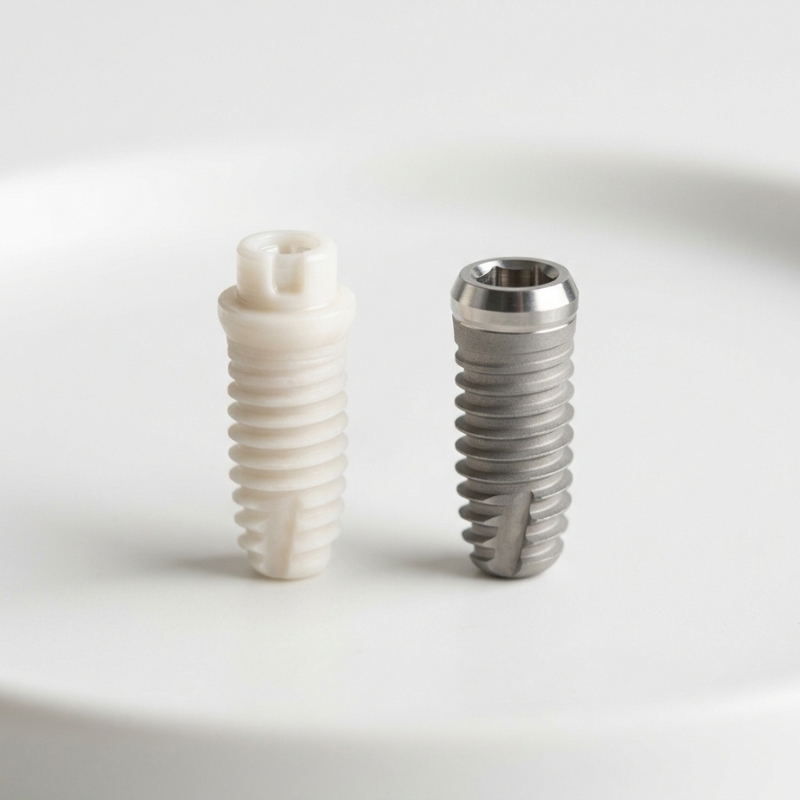
A zirconia dental implant is an implant whose fixture and abutment are made of zirconia, a white ceramic in the same family of materials already used for dental crowns. There is no metal in it, which is what metal-free dental implants means on this page.

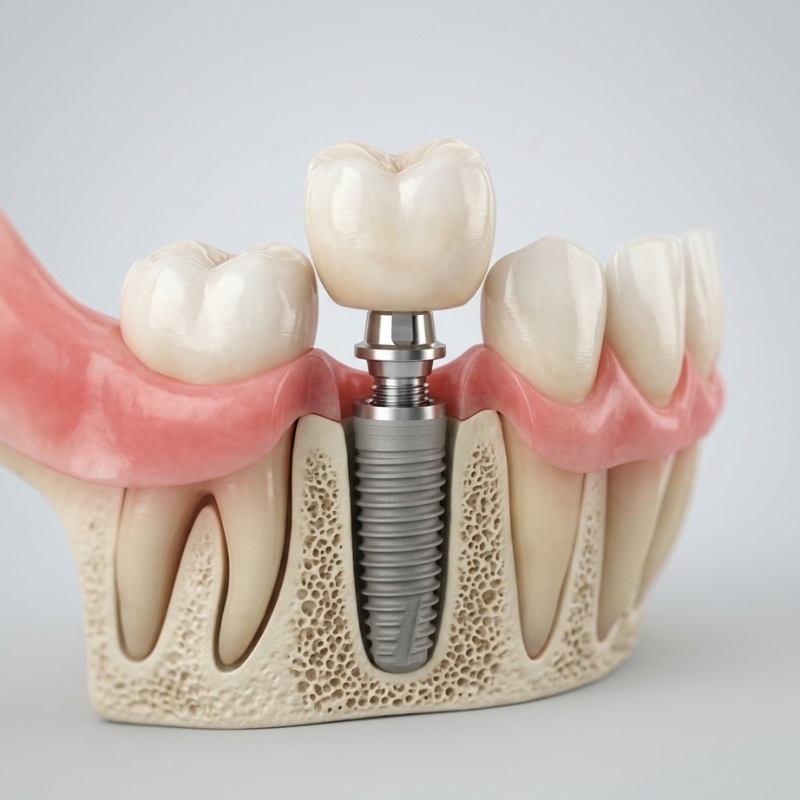
Every dental implant, ceramic or titanium, has the same three parts. The fixture is the post that is placed into the jawbone and replaces the tooth root. The abutment is the connector that sits at the gum line. The crown is the visible part of the tooth. In conventional titanium dental implants, the fixture, and usually the abutment, is made of titanium. Ceramic dental implants are not.

Ceramic implants come in one-piece and two-piece designs. A one-piece implant is a single component, fixture and abutment together. A two-piece implant has a separate abutment, which gives more control over the angle the crown sits at, and that matters most at the front of the mouth, where the tooth has to line up with the ones beside it.

We use the ZERAMEX two-piece ceramic system. Implant systems are not interchangeable, and pooled research has found that implants from discontinued brands survive less well than those from established, currently marketed systems. Hence, the choice of system is a clinical decision rather than a preference.


Zirconia or Titanium, How the Two Compare

Titanium has the longest published clinical record, and zirconia has a tooth-coloured appearance and no metal. For most patients, either material will work, so the choice is made on a case-by-case basis rather than as a rule.


Consider Zirconia (ceramic) Titanium
Material White ceramic, no metal Titanium alloy
Appearance at the gum line Tooth-coloured, no grey shadow where gum tissue is thin Can show as a grey line through thin gum tissue
Published clinical record Good, but shorter. The pooled data spans about ten years. Longer. Ten-year data across many prospective studies.
Behaviour under load Ceramic so that it can fracture rather than bend Metal, so it deforms rather than fractures
Design options One-piece and two-piece systems Wide range, long-established
Commonly used for Front teeth, thin gum tissue, patients who want no metal The default in most cases, including complex ones

Zirconia ceramic implants and titanium implants compared

What the research says

A 2024 systematic review and meta-analysis in Clinical Oral Investigations pooled 25 studies covering 4,017 zirconia implants in 2,083 patients and reported a ten-year cumulative survival rate of 95.1 per cent. Fracture accounted for 26 of those implants, or 0.65 per cent (Mohseni, Soufi and Chrcanovic, 2024).

For context, a 2019 systematic review in the Journal of Dentistry, covering 18 prospective studies of conventional implants, reported a 10-year survival of 96.4 per cent, falling to 93.2 per cent after adjustment for patients lost to follow-up (Howe, Keys and Richards, 2019).

When compared directly, a 2023 meta-analysis in Clinical Oral Investigations found no statistically significant difference in survival between the two materials, based on two randomised trials involving 199 implants followed for 12 to 80 months. The authors describe the finding as short-term (Padhye and others, 2023).

The honest position is that zirconia has less long-term evidence behind it than titanium, and the researchers say so themselves. We would rather tell you that than leave you to find it out afterwards.

Who Are Metal-Free Implants For?

Zirconia implants suit four groups of patients, and only one of those four involves an allergy.

  •     Thin gum tissue at the front of the mouth. This is the most common clinical reason. Where the gum is thin, a metal fixture beneath it can appear as a grey shadow along the gum line. A white ceramic one does not, so the result holds up better over time in the part of the mouth people actually see.
  •     A known sensitivity to metals. Some patients have reacted to metal elsewhere, in jewellery or in an orthopaedic implant, and would rather not find out whether the same applies here.
  •     A preference not to have metal placed in the jaw. This is a reasonable choice in its own right, and it does not need a medical justification attached.
  •     Patients are already looking for a metal-free option. If you have been researching ceramic or non-metal dental implants and want a practice that offers them, we do, alongside conventional titanium dental implants, and we will tell you honestly which one suits your case.

 It is worth being clear about the allergy question because much of the material online is not. A confirmed allergy to titanium is uncommon. Most patients who choose a ceramic implant do so for the appearance, or simply because they prefer it, and both are perfectly good reasons. We are not going to tell you that you have a problem you have not been diagnosed with.

What the Treatment Involves, Stage by Stage

Implant treatment runs across six stages, and most of the time, between the first and the last is spent waiting for the bone to heal rather than in the chair.

Here’s a preview of what your website’s text will look like by default. You can also adjust the typography of most elements separately. Note that the Font Size setting affects all the sizes defined in “rem” units, that is, almost all areas of your site.

  1. Consultation and assessment

We examine the site, obtain the necessary imaging, and assess whether there is sufficient bone to support an implant and enough space for the crown.

  1. Treatment plan and written quote

You get a written plan setting out how many implants are involved, whether any preparation is needed first, and what the whole thing costs before anything begins.

  1. Preparation, if it is needed

A failing tooth may need to be removed first, or the bone may need grafting where there is not enough of it to hold the implant. 

  1. Placing the implant

The fixture is placed into the jawbone under local anaesthetic. 

  1. Healing and osseointegration

Osseointegration is the process of bone growing onto the surface of the implant and locking it in place. It is what makes an implant a replacement root rather than a screw in a hole, and it cannot be rushed. 

  1. Abutment and crown

Once the implant has integrated, the abutment is fitted, and the final crown is made and placed. 

What Do Zirconia Dental Implants Cost in Australia?

There is no single price for a zirconia implant because the cost depends on how many teeth are being replaced and what needs to happen before the implant can be placed. As a guide to the market, Australian practices publishing their figures in 2026 quote a single ceramic implant at roughly $4,500 to $7,000 all up, covering the implant, the abutment and the crown, against roughly $3,500 to $6,000 for the equivalent titanium restoration. Those are other practices’ published figures and third-party survey ranges, not ours.

Here is what moves the number:

  • How many teeth are being replaced? Not every missing tooth needs its own implant, and the plan is what determines that.
  • Whether a tooth needs removing first. An extraction is a separate step with its own cost.
  • Whether bone grafting or a sinus lift is needed. This is the single largest variable, and it is why two patients quoted for one implant can get very different numbers.
  • Which system and component design is used? One-piece and two-piece ceramic systems are not priced the same.
  • The crown, and where it is made. Material and laboratory both affect the figure.
  • Imaging, and whether a surgical guide is used. A guide adds cost at the planning stage and removes it from the surgical stage.
  • Your health fund. Cover for implants varies widely by fund and level. We can provide the item numbers so you can check your rebate before you commit to anything.

The only accurate implant quote is one written for your mouth after we have assessed the bone and the space we are working with. Book an implant consultation, and we will assess you, explain whether zirconia or titanium suits your case better, and put the full cost in writing.

The Limits of Zirconia Implants

A ceramic implant is not the right answer in every case, and there are three things worth knowing before you choose one.

  • Ceramic behaves differently under load. Metal bends; ceramic can fracture. In pooled data from 4,017 zirconia implants, fractures accounted for 0.65 per cent (Mohseni and others, 2024). That is uncommon, but it is a material-specific risk, and you should hear it from us.
  •  There is less long-term evidence than for titanium. The ten-year data on zirconia is good. There is simply less of it, and it comes from smaller studies.
  • Not every case has enough bone. Grafting can often make an implant possible where it otherwise would not be, but sometimes an implant is not the right treatment at all, in which case a bridge or a denture may serve you better. We will say so.

 Smoking, uncontrolled diabetes and untreated gum disease all affect how well any implant integrates, whether ceramic or titanium. We assess and manage these before treatment rather than discovering them afterwards, which usually means treating gum disease first.

If you’re looking for a dentist in Sydney who takes genuine care in their work and the well-being of his or her patients, call today and let Dr Choo, Dr Ip and their friendly staff look after you, your family and those pearly whites!

Book a consultation at our Marsfield Dental Clinic or Book Online

Related Blog Posts About Dental Implants

Zirconia Implants in Marsfield, Macquarie Park and Ryde

Our practice is at 52 Waring Street, Marsfield NSW 2122, next to Woolworths, with on-site parking. We are open Monday to Friday from 9 am to 6 pm and Saturday from 9 am to 4 pm.

We see implant patients from Marsfield, Macquarie Park, North Ryde, East Ryde, Ryde, West Ryde, Eastwood, Epping, Denistone and Putney. Implant treatment at the practice is carried out by Dr Andrew Ip, who holds a Master of Science in Implantology and Dental Surgery and a postgraduate diploma in Clinical Dentistry in Oral Implants, alongside Dr Mary Choo. Our team speaks English, Mandarin, Cantonese, Hokkien, Malay and French.

Call us on (02) 9887 1961 to arrange a consultation, or use the enquiry form on this page—more about our Marsfield practice.

Zirconia Dental Implants: Your Questions Answered

Metal-free dental implants are made from zirconia, a tooth-coloured ceramic, rather than titanium.

They serve the same purpose as a conventional implant: a post placed into the jawbone to support a crown replacing a missing tooth, but containing no metal.

Marsfield Dental Care offers metal free dental implants in Sydney using the ZERAMEX ceramic implant system.

Zirconia implants are typically chosen by patients who prefer to avoid metal for personal reasons, who have a confirmed sensitivity, or who are concerned about a grey shadow showing through thin gum tissue at the front of the mouth.

Whether a zirconia or titanium implant is more appropriate for your case is determined at assessment.

Australian practices’ publishing figures in 2026 quote roughly $4,500 to $7,000 for a single ceramic implant, including the abutment and crown, against roughly $3,500 to $6,000 for titanium. The number depends most on whether bone grafting is needed. We provide a written quote after assessing you, and we can give you item numbers for your health fund. 

Both are strong enough for normal chewing. They fail differently: titanium deforms, ceramic can fracture, which occurred in 0.65 per cent of 4,017 implants in the pooled research (Mohseni and others, 2024). Titanium has the longest published record. Which one suits you is a case-by-case decision we make at the consultation.

A 2024 meta-analysis of 25 studies covering 4,017 zirconia implants reported ten-year survival of 95.1 per cent (Mohseni, Soufi and Chrcanovic, 2024). That is a strong figure, but the long-term data on zirconia is shorter and comes from smaller studies than the equivalent data on titanium, and it is fair to say so.

The fixture and the abutment are ceramic, with no metal in them. In a two-piece system, the components are joined by a connecting screw, and the crown is a separate restoration. 

Most of the time is spent waiting for the bone to heal onto the implant rather than in the chair. Treatment runs from the consultation, through placement, through a healing period, to the final crown. 

The implant is placed under local anaesthetic, so you should not feel pain during the procedure itself. Soreness and some swelling for a few days afterwards are normal and are usually managed with ordinary pain relief. We will tell you what to expect and what to do if it does not settle.

Yes, and the front of the mouth is where the tooth-coloured fixture is most useful. Gum tissue at the front is often thin, and a metal fixture beneath it can show through as a grey shadow at the gum line over time. A ceramic fixture does not have that problem.

Bone grafting or a sinus lift can often build up enough bone to hold an implant, and we assess this at the consultation with imaging rather than guessing at it. Where an implant is not the right treatment, a bridge or a denture may suit you better, and we will talk you through both.

At our practice at 52 Waring Street, Marsfield NSW 2122, next to Woolworths, with on-site parking. We are open six days a week, including Saturday, until 4 pm, and we see implant patients from Macquarie Park, North Ryde, Ryde, Eastwood, Epping, and the surrounding suburbs. Book an implant consultation or call (02) 9887 1961.

Book an Implant Consultation

Book an implant consultation, and we will examine the site, take the necessary imaging, tell you whether a zirconia or titanium implant suits your case, and put the full cost in writing before anything begins. Call (02) 9887 1961 or use the contact form, and we will find you a time that includes Saturdays.

(02) 9887 1961